English




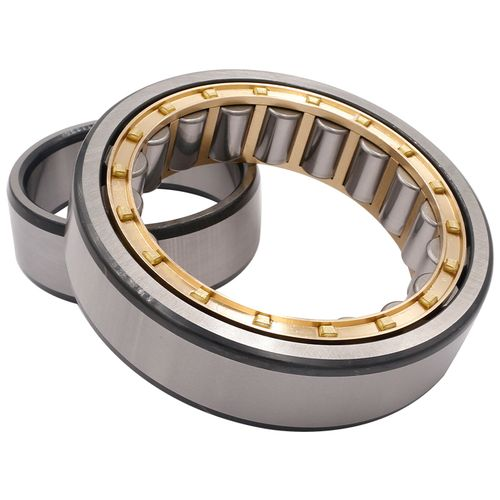
Roller bearings, which use rollers as rolling elements (cylindrical rollers, tapered rollers, spherical rollers, etc.), have a large contact area, high load capacity, and superior impact resistance compared to ball bearings. They are suitable for medium to heavy loads and high-impact conditions, and mainly include the following types:
★ Cylindrical roller bearings: These have extremely high radial load capacity and allow free axial movement. They are suitable for heavy-duty, high-speed applications with axial thermal expansion, such as machine tool spindles, motor rotors, and rolling mills. They are available in single-row, double-row, and multi-row subtypes.
★ Tapered roller bearings: These have tapered rollers and can withstand both radial and axial forces simultaneously. They have a high load capacity and are suitable for heavy-duty, combined-load applications such as automotive wheel hubs, gearboxes, and construction machinery. They are usually installed in pairs.
★ Spherical roller bearings: These have a self-aligning function, compensating for shaft deflection and installation misalignment. They can withstand radial forces, small axial forces, and impact loads. They are suitable for applications prone to installation misalignment or vibration, such as paper machinery, mining machinery, and vibrating screens.
★ Needle roller bearings: These have thin and long rollers, resulting in a very compact axial dimension and high radial load capacity. They are suitable for heavy-duty applications with limited space, such as automotive transmissions, motorcycle engines, and small gearboxes. However, they have weaker impact resistance and require high shaft hardness.
Do you have
any question? Call



 Add:Precision Bearing Industrial Park in Guantao County, Hebei Province.
 Tel:China: +86-635-8550888 Korea Branch: 032-213-8882 Fax:032-213-8883
 Email:China: bearing@jito.cc
  Web:www.jito-bearing.com